About the Asian Spinal Cord Network
The Asian Spinal Cord Network (ASCoN) is a regional professional network dedicated to improving spinal cord injury (SCI) care across Asia through collaboration, education, research, and advocacy.
Our Mission
To strengthen spinal cord injury services across Asia through regional collaboration, knowledge exchange, and high-quality professional education.
Our Vision
A continent where every person living with spinal cord injury has access to high-quality, evidence-based rehabilitation, long-term care, and opportunities for meaningful community reintegration.
Background
ASCoN was established in 2001 through the collaboration of leading spinal cord injury centres and professionals across Asia, in response to significant regional disparities in SCI care and rehabilitation services.
The network is co-ordinated by the Centre for the Rehabilitation of the Paralysed (CRP), Bangladesh, and operates in affiliation with the International Spinal Cord Society (ISCoS).
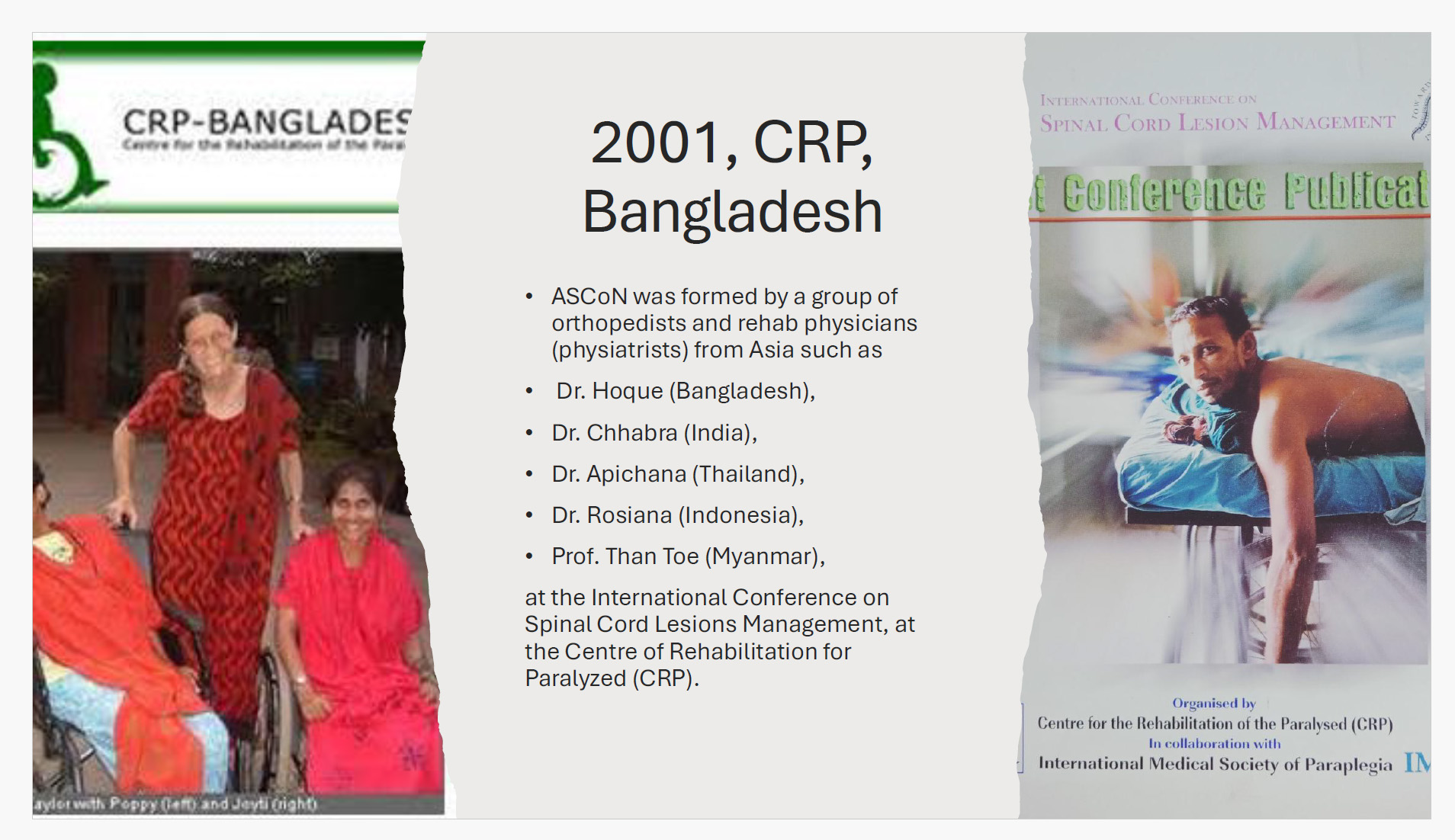
Founded in 2001 — CRP, Bangladesh
- ASCoN was formed by a group of orthopaedists and rehabilitation physicians from across Asia.
- Founding contributors included clinicians from Bangladesh, India, Thailand, Indonesia, and Myanmar.
- The initiative emerged during the International Conference on Spinal Cord Lesion Management.
- The meeting was hosted at the Centre for the Rehabilitation of the Paralysed (CRP).
This founding meeting marked the beginning of a sustained regional collaboration, laying the groundwork for ASCoN’s role in education, research, service development, and advocacy for spinal cord injury care across Asia.
Strategic Priorities
Training and Service Development
Strengthening clinical capacity and multidisciplinary practice across the region.
Educational Resources
Developing accessible, context-appropriate materials for healthcare professionals.
Networking & Knowledge Exchange
Facilitating collaboration and sharing best practice across institutions.
Research & Data Collaboration
Supporting shared data and evidence-based improvements in SCI care.
Policy & Advocacy
Advocating for improved recognition and resourcing of SCI services.